 |
||||
A Journey from Ro to the Go. Through out our lives we are judged on a number of qualities. Our appearance, our charisma, our athletic prowess. Yet
literacy despite the Krudd government's rhetoric of 'back to basics' is
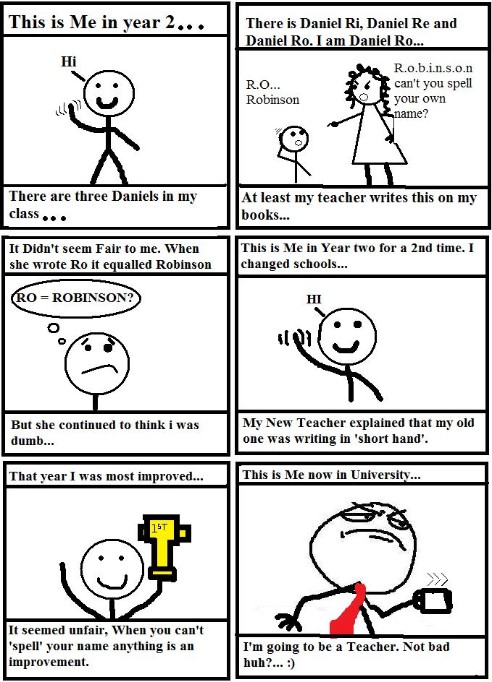
poorly understood. I'll test your literacy right now. into thinking that a stick man comic is indeed simple. Well brush up on your critical literacy, because you have been tricked. Within this comic a reader needs to know not only how to read the text. The reader must also be literate in symbolism, use of colour and even an understanding of the internet discourse surrounding the use of emoticons. This deceptive multimodal text not only demonstrates the varied literacies we as human beings employ in life. It also conveys a very personal look into my education. I am the main protagonist. Despite my razor sharp reasoning and comprehension skills. My choice to copy the 'shorthand' as modeled by my teacher resulted in people judging me to lack intelligence. Now at the time I did not understand exactly what had happened. Merely that my teacher had modelled a form of literacy and I had copied her. Of course this is to be expected at this age in a child’s life. After all according to the theorist Piaget I was only at the age of the properational, in his outline of cognitive development (Woolfolk, 2007). This in short could be described as a ‘monkey see monkey do’ age, where a child models their understanding of language based on what they experience. The case could be made that I was simply acting as a code breaker, as described by Freebody and Luke under the Four Resources Model. I fit the Code Breaker category as at the time I understood the relationship between the idea of RO being a representation of Robinson, I had no idea why it did (MyRead, 2007). Or that is at least I could not verbalise my understanding of it. If I had been able to properly verbalise my understanding, then perhaps I would have made the jump to being classified as a Text Participant.
Consequently had I been able to demonstrate that knowledge I would not have experienced the negative appraisal of my intelligence. More over that judgement that was made on me also coloured other areas of my schooling life. Teachers began to see me as a negative influence in classrooms and the school. Somehow the perceived lack of intelligence somehow had me placed in the same category as the habitual trouble makers and disruptive students. I was in effect locked out. This scenario is similar to the one outlined by Allan Luke in his paper Literacies as a Social Practice (Luke, 1991). Luke says that literacies are connected to educational and social power. In my case my education was being hampered and I was being social power was incredibly limited. Zevenberg, to name drop another academic, wrote on the concepts of grouping students based on the idea of a perceived ability (Zevenberg, 2001). Of course he mentions that sometimes grouping can occur with bad information.
This experience is why I became very passionate about literacy in general. I understood the power that came with a command of the English language. Most people feel that the ability to read the newspaper allows them to be informed and ‘quite clever’. However as the average reading age for a newspaper is around fifteen years old, I am not sure how clever they should really feel. After all if they were indeed truly literate they would be operating at the level of a Text Analyst. They would know that texts are not neutral and that they act to influence the reader. However, sadly most do not accept this. Yet they never seem to question why they now take extra notice of that P plater driving in front of them. Or why they lost their minds over a man saying sorry to a group. Or even why the slogan Kevin07 was so ‘mind blowing’ to them. Or more recently perhaps why ‘teachers’ think the myschools website is such a bad invention. Instead they think it is about teachers trying to ‘hide’ something.
Ask yourself if you hold this view two things. A ) why do I hold it? B ) when did it come into my focus?
The truth is that the ‘back to basics’ style of literacy is simply part of a larger debate over schooling in general that goes back to the debates about ‘critical literacy’. Perhaps the biggest issue I find is that when the focus is on someone’s basic literacy how many stories like mine exist out there. When basic literacy is considered to be linked to intelligence then the cycle I have described continues. More to the point if the habit is to teach people to be merely Code Breakers then how are we to also meet the objective of creating ‘informed and active citizens’, as the Syllabus in education demands (syllabus). At the risk of sounding rather Orwellian about the issue, how can we call ourselves informed citizens when we can not even deal with the fact that the reading age of a newspaper is that of the ‘youth’ that readers look down on as naïve.
In the end Literacy is far too wide reaching a concept to be nailed down to simple ‘back to basics’ approach. As much as KRudd and the general public would like it to be. Literacy is anything but basic.
But do not feel too bad just listen to the Song Little Boxes again because it perfectly supports the aim that a back to basics approach in regards to literacy and education would create.
Resources: Anita Woolfolk, K. M. (2007). Educational Psychology. Frenchs Forest: Pearson Education Australia. MyRead. (2007). What successful Readers Do. from http://www.aate.org.au/myread/what.htm Studies, B. o. (2003). English 7-10 Syllabus. Sydney: Board of Studies NSW. Zevenberg, R. (2001). Is Streaming an Equitable Practice? Students' Experiences of Streaming in the Middle Years of Schooling. Numeracy and Beyond. |
||||
